
ABOUT NEXUS
ENDURING PROSPERITY
Nexus Protocol PBC is a regional-development platform focused on a single objective:
Enduring Prosperity
Nexus was founded around a fundamental question:
How can regions expand their capacity to create, sustain, renew, and expand prosperity over time?
Human needs continue to grow while many of the resources and systems required to support prosperity face increasing constraints, including land, water, energy, environmental capacity, institutional capacity, public budgets, and human attention.
Nexus does not assume that every constraint must simply be accepted and managed. Some may require adaptation. Others may be reduced or overcome through infrastructure, technology, institutional capacity, capital, or better relationships among systems.
The challenge of the twenty-first century is therefore not growth alone. It is expanding the capacity for enduring prosperity.
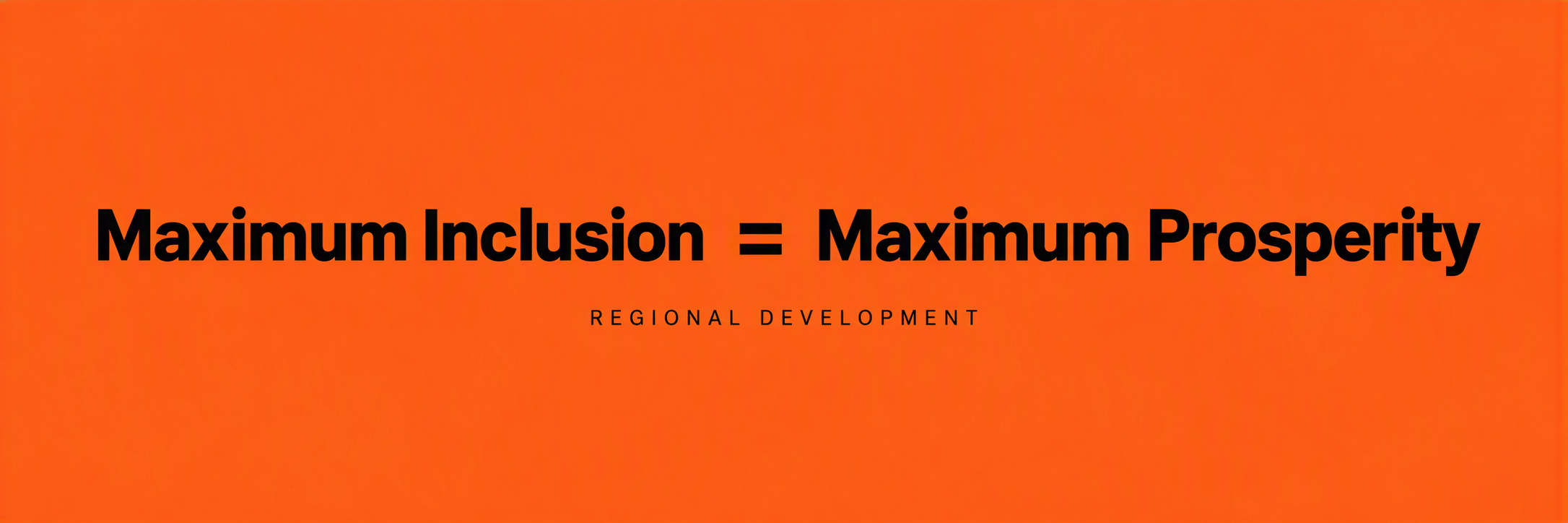
MAXIMUM INCLUSION
Nexus begins with a hypothesis: a region's capacity for enduring prosperity may expand as more people, communities, institutions, enterprises, investors, governments, infrastructure systems, and living systems are able to participate productively in creating value.
Inclusion is not an argument for involving everyone in everything. Participation must create value rather than unnecessary complexity, dependency, or institutional burden.
For Nexus, inclusion extends beyond human participation. It also considers institutions, infrastructure, environmental systems, future generations, and living systems affected by regional development.
ABUNDANCE & SYMBIOTIC INFRASTRUCTURE
Nexus asks whether critical infrastructure can do more than manage scarcity.
Abundance Infrastructure examines whether water, energy, mobility, development, digital infrastructure, and other essential systems can responsibly expand the capabilities available to people, communities, institutions, and economies.
Symbiotic Infrastructure examines whether relationships among infrastructure systems can create additional value that would not exist in isolation.
The objective is not abundance without limits or integration for its own sake. Some constraints cannot responsibly or economically be overcome, and some systems perform better independently.
The question is empirical: where can capability be expanded, where can systems reinforce one another, and where does integration create more burden than value?
REGIONS ARE A CRITICAL SCALE OF PROSPERITY
Housing, mobility, water, energy, labor markets, infrastructure, capital, environmental systems, development, and governance often interact at regional scale.
Nexus therefore uses the region as a principal unit of inquiry while recognizing that regional systems operate within larger national and global systems.
THE ALIGNMENT PROBLEM
Regions can possess substantial infrastructure, capital, institutions, expertise, land, technology, and public authority without converting those capabilities into enduring prosperity.
Nexus refers to this as the Alignment Problem.
The question is not simply how to integrate regional systems. It is whether particular relationships among distributed capabilities can create additional value without introducing greater complexity, cost, dependency, governance burden, or risk.
RELATIONSHIP ECONOMICS
To evaluate those relationships, Nexus uses Relationship Economics, a decision framework built around a simple question:
Does coordination create more value than burden?
Coordination is not inherently beneficial. Integration is not presumed.
Systems should remain independent where independence creates greater net value.
REGIONAL DEVELOPMENT
Infrastructure, governance, institutions, capital, ownership, stewardship, technology, public benefit, and regeneration are not ends in themselves. They are potential instruments of regional development.
The objective is enduring prosperity.
Evidence determines which instruments matter, how they should relate, and whether intervention is warranted at all.
DEVELOPMENT GEOGRAPHY
Nexus is exploring a development hypothesis:
Infrastructure → Access → Development → Value → Reinvestment → Public Benefit & Regeneration
This sequence is not assumed.
Infrastructure does not automatically produce development. Development does not automatically produce broadly shared value. Value creation does not automatically produce public benefit or environmental regeneration.
Each relationship must be tested.
THE NEXUS FRAMEWORK:
Nexus is developing and testing a regional-development framework organized around:
1. Prosperity Under Constraint
What limits a region's capacity to create, sustain, renew, and expand prosperity?
2. Maximum Inclusion
Who and what can participate productively in creating enduring value?
3. Abundance Infrastructure
Where can responsible expansion of infrastructure and capability reduce constraints rather than merely manage scarcity?
4. Symbiotic Infrastructure
Where can relationships among infrastructure systems create additional value?
5. Multiple Verticals & Circularity
Which infrastructure, development, and economic activities are independently viable, and where can assets, outputs, residuals, or capabilities create productive relationships among them?
6. Relationship Economics
When does coordination create more value than the burden it introduces?
7. Development Geography
How do infrastructure, access, development, and value creation interact across a region?
8. Governance & Institutional Architecture
What responsibilities, authorities, interfaces, and institutional relationships are appropriate?
9. Ownership, Stewardship & Institutional Succession
What structures appropriately align capital, risk, ownership, public participation, incentives, and long-duration responsibility?
Institutional Succession asks a longer-term question: should the institution best suited to develop an asset necessarily be the institution best suited to own or steward it indefinitely?
Potential structures may allow development capital to recover invested capital and earn an appropriate return before some or all ownership transitions to a long-term stewardship structure appropriate to the asset and regional context.
No ownership pathway is presumed. Its commercial, legal, fiscal, governance, and public-benefit implications must be independently validated for each application.
10. Public Benefit & Regeneration
How can regional development strengthen human, economic, social, and environmental capacity over time?
11. Validation Discipline
What does the evidence support, and what should advance, remain independent, change, or stop?Nexus is particularly interested in how ownership, public and private participation, capital, and long-term stewardship can be structured to align incentives across the life of an asset, and in whether ownership and stewardship should evolve as projects mature.
EVIDENCE DETERMINES WHAT SURVIVES
Every region is different. Every application must be independently evaluated and locally adapted.
No geography, model, infrastructure system, architecture, ownership structure, governance framework, capital structure, or Nexus proposition is entitled to advancement.
Evidence determines what survives.
DIFFERENT REGIONS. DIFFERENT PROBLEMS
Some regions must manage rapid growth. Others face infrastructure deficits, resource constraints, institutional limitations, environmental pressures, declining capacity, or combinations of these conditions.
Nexus begins with the conditions of the region, not a predetermined development model.
Vision at scale. Discipline at every gate.