
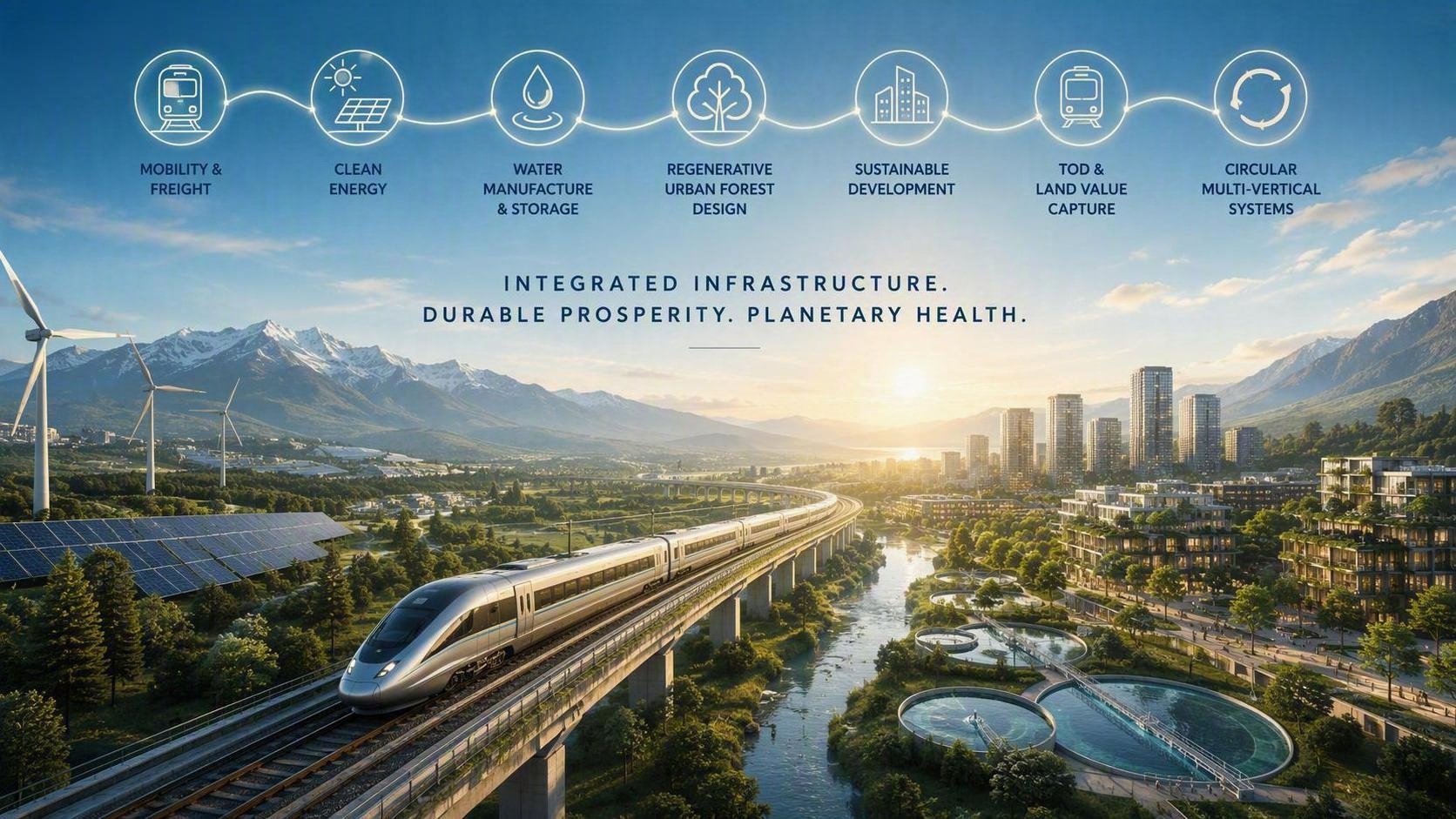
NEXUS PHILOSOPHY
Building Infrastructure for Human Prosperity and Planetary Health:
Nexus Protocol PBC exists to explore a simple but consequential idea:
Commercial prosperity, community prosperity, and planetary health should not be treated as competing objectives.
We believe the future will require infrastructure systems that create durable economic value while strengthening the communities and natural systems that support long-term human flourishing.
Colorado Genesis Phase 1A is the first major initiative being evaluated through this philosophy.
Why Nexus Exists:
The modern world tends to separate systems that are deeply interconnected.
Transportation is planned separately from energy.
Energy is planned separately from water.
Water is planned separately from development.
Development is planned separately from ecological systems.
Nexus explores whether stronger long-term outcomes may be possible when these systems are intentionally designed to reinforce one another.
The objective is not integration for its own sake.
The objective is to create more resilient, efficient, prosperous, and durable systems than would be possible if each component were developed independently.
Our Guiding Principles:
Individual Growth and Collective Growth Are Interdependent
Individual prosperity does not exist in isolation.
People thrive when communities thrive.
Communities thrive when the systems that support them remain healthy, resilient, and productive.
Long-term individual success and long-term collective success are connected.
Collective Growth Includes Both Human Systems and Natural Systems
Collective growth is more than economic expansion.
It includes:
Strong communities
Economic opportunity
Resource security
Institutional resilience
Environmental regeneration
Long-term planetary health
Nexus views human systems and natural systems as interconnected parts of a larger whole.
Commercial Growth That Damages Collective Growth Is Ultimately Self-Defeating
Economic activity can create extraordinary value.
But commercial growth that degrades communities, weakens institutions, exhausts resources, or damages ecological systems ultimately creates new liabilities for society and for the economy itself.
Nexus therefore seeks forms of development where commercial prosperity and collective prosperity reinforce one another.
The objective is not growth at any cost.
The objective is durable prosperity.
Planetary Health and Human Prosperity Must Be Designed Together
Nexus rejects the assumption that environmental performance and economic performance exist in permanent opposition.
Long-term infrastructure should seek opportunities where:
Economic growth
Resource resilience
Environmental performance
Community outcomes
strengthen one another rather than compete with one another.
Stewardship Is a Core Economic Function
Infrastructure, capital, governance, land, water, development, and ecological systems all require stewardship.
Stewardship is not external to economic activity.
It is part of economic activity.
Long-duration value depends on long-duration care.
Our Operating Principles:
Commercial Viability Matters
Impact must be supported by credible economics and durable operating models.
Mission does not replace viability.
Integration Must Earn Its Complexity
Every connection between systems must create identifiable value, resilience, efficiency, optionality, or impact.
Integration is not an end in itself.
Validation Precedes Scale
Ideas must be tested before significant capital is deployed.
Colorado Genesis Phase 1A exists to evaluate technical, economic, legal, environmental, governance, and institutional viability before larger-scale development is considered.
Multiple Forms of Value Matter
Nexus evaluates:
Financial value
Economic value
Social value
Environmental value
Resilience value
Each matters.
None should automatically be assumed to replace another.
The Nexus Platform: Integrated Infrastructure Components
Nexus currently evaluates a coordinated platform consisting of:
Mobility & Freight
Clean Energy
Water Supply, Reuse & Storage Pathways
Regenerative Urban Forest Design
Sustainable Development
Transit-Oriented Development & Land Value Capture
Circular Multi-Vertical Systems
The Nexus Question:
The central question that drives our work is:
Can a coordinated portfolio of infrastructure, development, and natural-system interventions create more durable value than the same components planned, financed, governed, and operated independently?
Colorado Genesis Phase 1A exists to help answer that question.
Colorado Genesis Phase 1A:
Colorado Genesis Phase 1A is a structured validation initiative designed to evaluate integrated infrastructure opportunities across mobility, energy, water, development, and related systems in Colorado.
The purpose of Phase 1A is not to assume viability.
The purpose is to determine what opportunities, if any, are technically, economically, legally, environmentally, and institutionally viable before larger-scale development capital is deployed.
Colorado: The First Iteration
Colorado Genesis is the first proposed geographic iteration of Nexus Protocol.
Phase 1A is designed to determine whether a coordinated regional platform can be commercially viable, sustainable, resilient, and capable of supporting itself by evaluating the interactions among mobility, energy, water, development, governance, environmental systems, and public benefit within a single regional context.
If validated, the resulting methods, governance lessons, capital-formation insights, and platform principles may inform future region-specific Nexus iterations in other geographies around the world. Replication does not mean copying Colorado. Each future geography would require its own evaluation, stakeholder alignment, governance design, environmental review, economic assessment, and capital-formation strategy.
A broader question also underlies this work:
Can a more panoramic approach to infrastructure and development help regions address complex challenges where water, energy, mobility, economic opportunity, and long-term resilience must be expanded simultaneously, but where the scale and interconnected nature of those challenges often exceed the capacity of traditional project-by-project planning and financing approaches?
Colorado Genesis is the first proposed environment in which to explore that question. If the approach proves capable of creating measurable value in Colorado, the lessons learned may help inform future Nexus iterations in other regions, subject to independent validation and local adaptation.