
Global Economies Index (GEI)
GEI Founding Edition: Global Candidate Review Draft
Top 100 Territorial Economies
Introduction
What constitutes an economy?
Economic rankings traditionally focus on sovereign countries. Yet meaningful territorial economies also exist at other officially recognized levels, including supranational economies, official statistical regions, US states, provinces, territories, and separately reported economies.
The Global Economies Index was created to compare these territorial economies through a common, source-controlled framework using publicly reported economic, demographic, geographic, and institutional data.
For GEI purposes, an economy is an officially recognized territory for which current-price economic output is reported directly or can be reproduced from official constituent data. Inclusion does not imply equal sovereignty, political status, or governance authority. The index compares measured economic scale only.
Scope
The Founding Edition screens territorial economies that satisfy both numerical thresholds:
Resident population of at least 1,000,000
Nominal GDP or equivalent territorial output of at least US$1 billion
A qualifying record must also have a defined territorial boundary; recognition by a governmental, intergovernmental, or statistical authority; officially reported or reproducibly derived output; sufficient metadata to identify the measure, period, units, currency, source, and calculation; population and area observations; a documented economy type; and an overlap relationship where applicable.
Missing information is treated as Pending rather than as an automatic exclusion.
Understanding Economy Types
The GEI uses one record for each distinct territorial economy. Applicable recognition systems are retained in the metadata, but the same territory is not duplicated merely because it appears in more than one administrative or statistical classification.
Country: A sovereign country or other country-level economy reported through a recognized international statistical system.
Supranational economy: An officially constituted multi-country territorial economy with a defined composition and an official or reproducibly derived aggregate output measure.
Official statistical region: A region defined by a governmental or statistical authority. The American West, for example, is the GEI display name for U.S. Census Region 4: West.
US State: A state of the United States. Familiar state rows use the concise public label “US State.”
Province: A recognized first-level provincial jurisdiction, such as a Canadian province or an equivalent province in another national system.
State or equivalent jurisdiction: A recognized first-level jurisdiction outside the United States. Where useful, the public label identifies the national family, such as German state, Brazilian state, Australian state, or Indian state.
Territory or separately reported economy: A territory, special jurisdiction, or separately reported economy with qualifying population, output, boundary, recognition, and metadata.
Important Overlap Warning
Some economies overlap geographically and economically. For example, the United States, American South, and Texas may all appear in the ranking. Likewise, the European Union, Germany, and a German state may appear independently.
These territorial economies may be compared. They should not be summed.
Compare across territorial economies. Do not add overlapping parent and constituent records.
Methodology Summary
Population: Resident population reported by an official statistical authority.
Economic output: Current-price nominal GDP, GRP, regional GDP, officially used territorial GVA where the conceptual difference is disclosed, or reproducibly derived current-price output from consistent official components.
Currency: Ranking values are presented in current U.S. dollars. Original currency, original value, conversion method, exchange-rate source, source year, release date, and revision vintage are preserved where conversion is required.
Observation year: The latest official completed current-price observation available is used. The data year is displayed for every economy. Forecasts are not ordinarily used in the principal ranking.
Ranking: Economies are ranked by full-precision nominal economic output. Displayed values may be rounded, but the controlled full-precision value determines rank.
Recognition: Every non-country record must identify its recognizing authority, official classification or legal status, territorial level, boundary source, output authority, direct or derived status, calculation method where applicable, and equivalent peer family.
Deduplication: One record is used for each distinct territorial economy. Multiple classifications do not create duplicate entries.
Inclusion threshold: Population of at least 1 million AND nominal GDP or equivalent territorial output of at least US$1 billion.
______________________________________________________________________________________________________
Featured Results
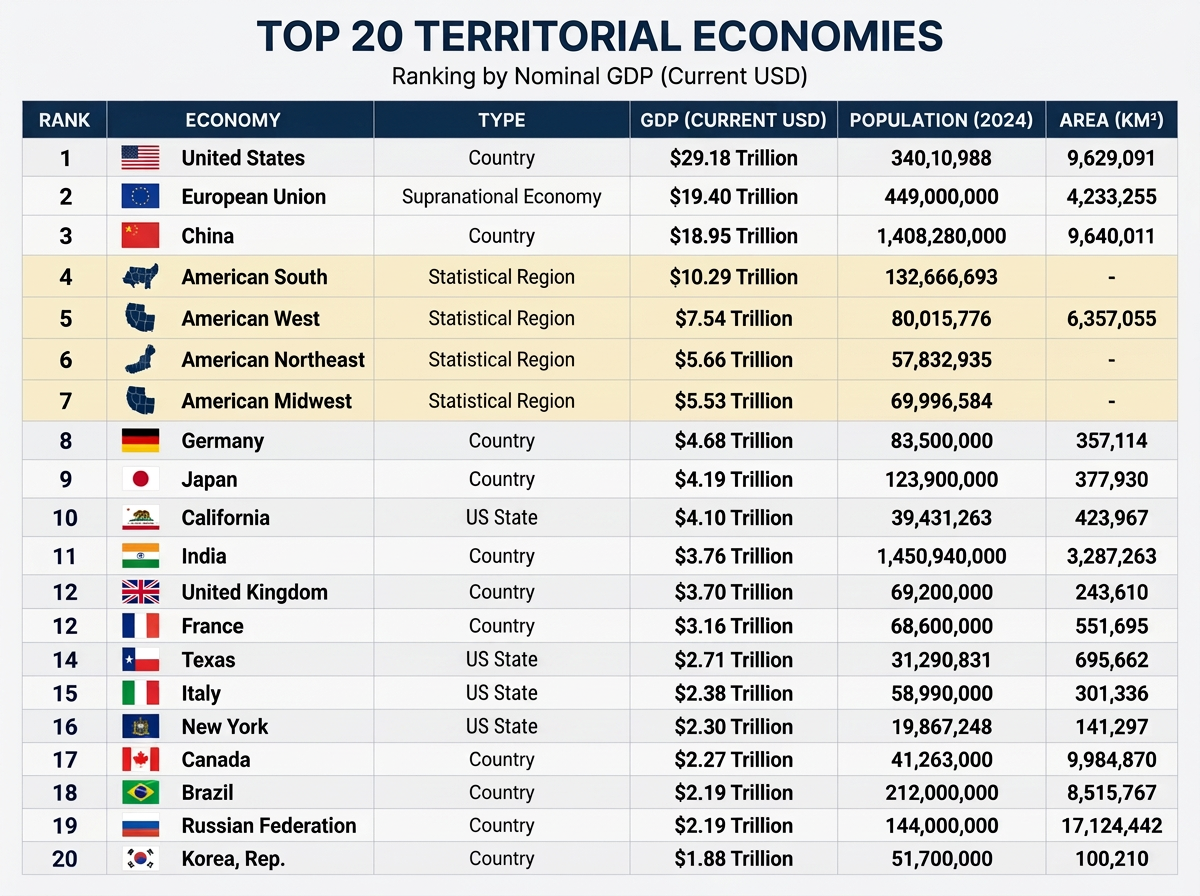
The featured ranking below highlights twenty of the world's largest territorial economies by current-price nominal economic output.
As candidate screening, source verification, and record-level review continue, rankings may change in future editions.
Complete GEI Dataset
The featured ranking below highlights twenty of the world's largest territorial economies in the GEI Founding Edition: Global Candidate Review Draft. As the candidate review, source verification, and record-level audit process continues, rankings and records may change in future editions.