
The Unsung Economy of the American West: $8 Trillion and 80 Million People
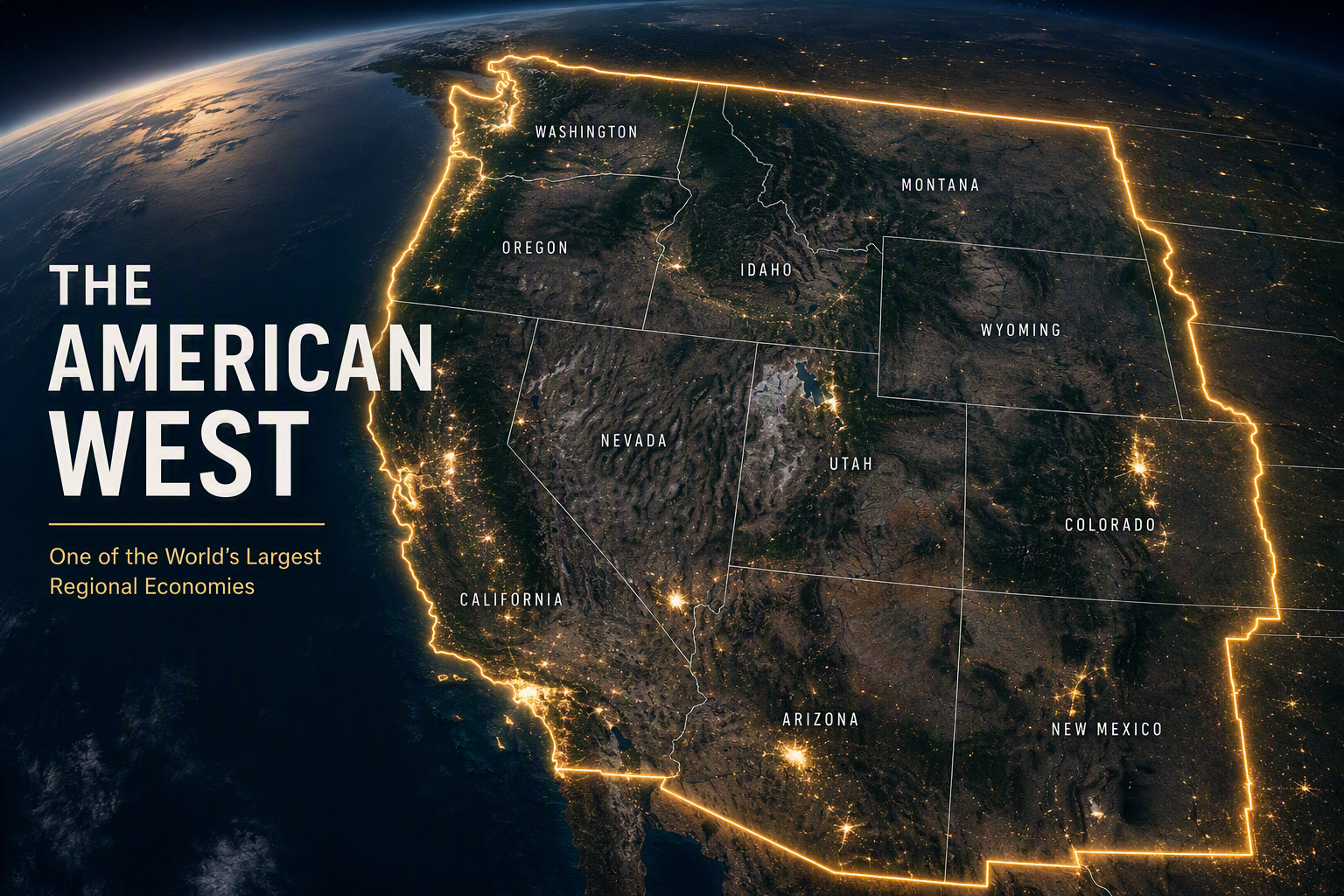
While researching regional development and regional economies, we found ourselves asking a simple question:
Why do we almost always talk about countries, states, and cities, but rarely about regions?
Countries are widely recognized as economic units. States and provinces are frequently analyzed. Major metropolitan areas receive enormous attention.
Yet there are many other officially recognized geographies that sit between them:
Statistical regions.
Economic regions.
Cross-jurisdictional regions.
Multi-state regions.
As we began exploring these territorial economies, we stumbled upon something surprising. The American West appeared to be one of the largest economies in the world. Using the official 13-state U.S. Census West geography and aggregating constituent economic output, the region reaches approximately:
80 million people
$7.5 trillion in annual economic output
That discovery immediately raised another question: If the American West is this large, why is it almost never discussed alongside the world's major economies?
So we started digging deeper. What actually constitutes an economy? Why are countries commonly included in economic rankings while other officially recognized geographies are not? Which territories, regions, states, provinces, and supranational entities are measured and reported, but rarely perceived as economies in their own right?
As we explored those questions, we discovered that statistical agencies around the world already recognize and report many territorial economies beyond countries. Some are supranational economies. Some are territories. Some are states and provinces. Others are officially defined statistical regions.
Many possess populations larger than entire countries and economic output that rivals major national economies. When we compared these territorial economies using a common framework, the results were striking:
See content credentials
At first glance, the ranking itself is interesting. But the ranking is not the real story. The real story is the question it raises.
Are Regions Becoming More Important?
Many of the systems that shape prosperity no longer operate neatly within political boundaries. In many cases, the relevant geography of a problem may be larger than the jurisdiction responsible for solving it.
Water systems cross state lines.
Energy systems connect multiple jurisdictions.
Supply chains span enormous geographies.
Labor markets extend beyond municipal borders.
Transportation corridors connect entire regions.
Housing shortages in one area create impacts somewhere else.
Technology ecosystems frequently emerge across multiple metropolitan regions rather than within a single city.
In many cases, the systems that shape prosperity appear to operate regionally. This is one reason the American West is so interesting. It contains major metropolitan economies, technology centers, agricultural regions, water systems, freight corridors, energy resources, research institutions, military assets, tourism destinations, and some of the fastest-growing communities in North America.
Yet we rarely discuss it as a single regional economy. Perhaps we should.
Why This Matters For Colorado:
This perspective is particularly relevant for Colorado. Colorado is often viewed through a state lens. But Colorado also sits within a much larger Western system. It occupies a strategic position between the Mountain West, Great Plains, Southwest, and broader Western markets.
It functions simultaneously as a headwaters state, transportation crossroads, technology center, energy producer, tourism destination, aerospace hub, and research center.
Viewed this way, Colorado's future may depend not only on what happens within Colorado itself, but also on the larger regional systems in which it participates.
Success Creates New Constraints:
One lesson has repeatedly emerged throughout our work: Successful regions create new constraints.
Prosperity creates demand. More residents require housing. More economic activity requires energy. More development requires water. More growth requires infrastructure. More complexity requires institutional capacity.
The challenge for successful regions is often not reversing decline. The challenge is managing success. This idea sits at the heart of a broader question we have been exploring:
How can cities and regions create more prosperity, resilience, and opportunity from limited resources?
A Bigger Question:
The American West ranking may ultimately matter less than the question it raises. For most of modern history, countries have been the primary unit of economic analysis. Perhaps the twenty-first century will increasingly require us to think about regions as well.
Not because regions replace countries. But because many of the systems that shape prosperity already operate at regional scales.
The American West may simply be one example of a much larger pattern. And understanding that pattern may help us better understand the opportunities, constraints, and challenges facing successful regions in the decades ahead.
Explore the Complete Global Economies Index
The ranking shown above is drawn from the GEI Founding Edition: Global Candidate Review Draft, the inaugural edition of the Global Economies Index. As candidate screening, source verification, and record-level review continue, rankings and records may change in future editions.